
The showers came and went all morning, never quite settling into rain proper but never clearing either, and by the time we had finished breakfast it was plain the walk up to Botenlauben was off. We had planned the climb through the woods to the castle, but the sky had other ideas, and I felt no particular loss in it. We have made that walk before, on drier days, and there is a comfort in knowing a place well enough to let the weather decide. So the day became a slow one by agreement, which suited us both.
We drove into Bad Kissingen and took lunch at one of the town’s bistros. I will not name it, partly because there are several and partly because the one worth recommending one year may have changed hands the next, so the name would only mislead anyone reading this later. The food was unfussy and good, and we sat over it a long while. The talk turned, as it has each evening this week, to the van. We are at the stage of reckoning with how much work is still ahead, which jobs we cannot do ourselves and will need to bring specialists in for, and how to keep the budget from running away, as it so easily does. I will set all that down properly another time, when the decisions are made rather than half-made. For now it is enough to record that the conversation widened rather than narrowed.
For those who follow, and we have now spent parts of three years coming back to this town, I want to put down what is worth seeing here while it is fresh enough to be useful.
Bad Kissingen lies in a valley on the Fränkische Saale, the Franconian Saale, which runs roughly north to south through the middle of it. That single fact shapes nearly everything. Because the town sits low, almost any walk out from the centre means climbing, and some of it climbs steeply. Around the spa quarter, though, the ground is gentle and given over to gardens and parkland, the Kurpark, the Altenberg, the Luitpoldpark and the Rose Garden, a dense green fabric laid out along both banks. The parkland spans the river, and throughout it deck chairs are set out for anyone to use, so that you can take your own patch of shade or sun and simply sit. I have always liked that. It asks nothing of you.
There is a scented path through the parkland, perhaps two hundred metres of it, that I think of separately from everything else. The roses there are not the formal kind in disciplined beds; they grow looser, wilder, and the scent of them gathers in the still air under the trees until it is almost a weight on you. On a warm afternoon you walk into it before you see it. The perfume reaches you first, heavy and sweet and faintly green at the edges, and for those two hundred metres the ordinary business of the day falls quiet. I have walked it more than once for no reason other than that.
The formal rose garden, the Rosarium, is a different thing and not to be confused with the path above. It holds something near ten thousand bushes, a hundred and thirty varieties, the colours running from pale yellow through pink to a deep red. It was opened in 1913 and laid out for the townspeople, as against the older spa garden that was once kept for paying guests. Worth a look, but it is the wild path that stays with me.
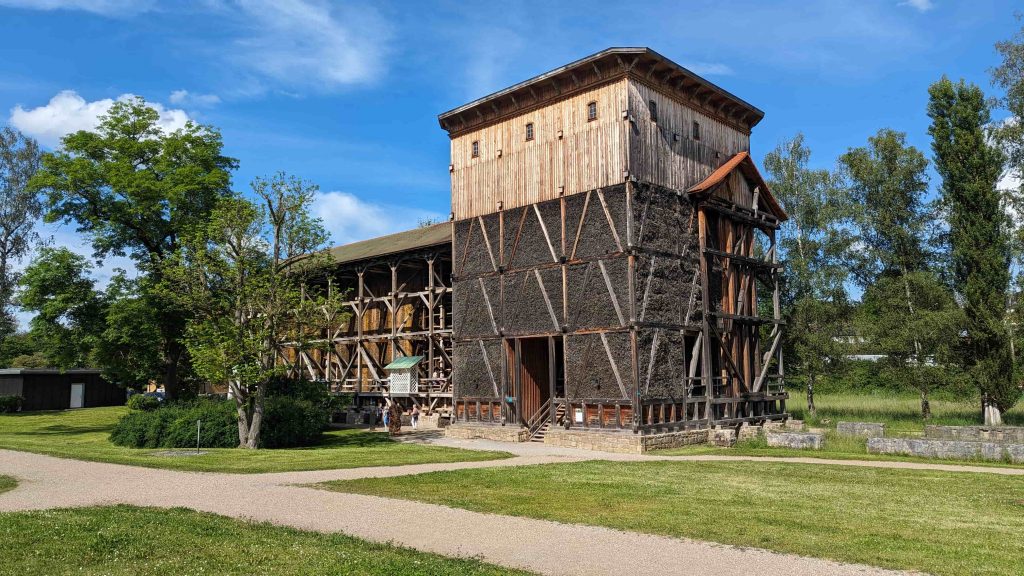
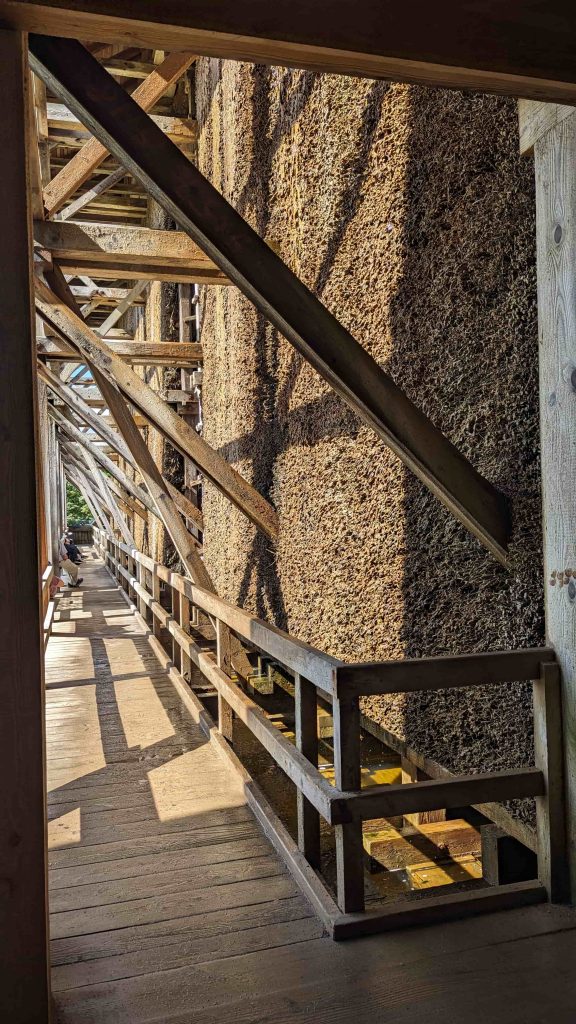
The graduation tower, the Gradierwerk, stands in the Luitpold Park and costs nothing to visit. A walkway along the Saale leads up to it. The town owes the structure to its old salt trade, and even now brine trickles down over walls of packed blackthorn brushwood on a great timber frame, throwing off a fine salt mist that is said to do the lungs good, something like the air off the North Sea. The thing that strikes you standing before it is that the whole of it is wood, a tall framework stuffed with thorn, far bigger than you expect. On an earlier visit we sat on the west side with the afternoon sun warm on our backs and the water cooling the air in front of us, breathing that clean salted air, and I came away genuinely persuaded that regular use of it would ease the breathing. I have two photographs I mean to keep with this: one of the whole timber structure in the sun (above), and one from the walkway inside (below), the brine-darkened thorn close at hand and the water running in its channel below. It is the inside shot that carries it.
The KissSalis Therme took us the better part of a half day. It is a large modern wellness complex, ten pools of various sizes inside and out across some eight thousand square metres, with nine saunas and steam baths besides. The big indoor and outdoor pools are made for families. There are treatment rooms you simply walk into, no booking, where you sit among strangers. Of the several kinds I remember only one clearly, so I will speak only of that: a saline mist room, an indoor and more concentrated cousin of the graduation tower. It was cool and thick with mist, the walls and floor finished in small mosaic tiles, with seats built into the walls, room for about a dozen at most. We stayed a quarter of an hour. On leaving you spray down the spot where you sat for whoever comes next, which is a civilised arrangement. The saunas sit within the textile-free section. Massages are easy to come by, and Ochi and I had a couples one, a head-to-toe thing lying side by side, which was as restful as anything we did all trip. One warning to pass on plainly: do not eat there, or if you must, go in with low hopes. We took dinner at the Therme and it was poor, a cheap set menu and dear for what it was.
Botenlauben Castle is the ruin we had meant to walk to today. It was the home of Otto von Botenlauben, a minnesinger and crusader, and his wife Beatrix de Courtenay. Otto was a songwriter of some standing, one of those gathered into the Codex Manesse, which I find a strange and pleasing thing to stand near. He sold the castle to the bishopric of Würzburg in 1234, and after that it passed through hands, fell into ruin, and was eventually quarried for its stone, so little is left. Two towers still stand, and you can climb both for a fine view over the town. There is a car park just beneath it for anyone who cannot manage the climb; on foot from the centre it is thirty to forty minutes, and a steep thirty to forty at that. Worth the effort even as a ruin.
The woodland walks wrap around that side of the town. They are beautiful and quiet and kept scrupulously clean. The tracks are compacted earth, the fire-road sort, with steps cut in where the slope steepens. What I remember is the smell: the resin of the spruce, and under it the damp leaf-litter, sweetish with a cool earthy note beneath, the kind the rain brings up. Birdsong the whole way round. It is as complete a disconnection from city and suburb as I know.
As for the town itself, it has been a UNESCO World Heritage Site since 2021, one of the Great Spa Towns of Europe alongside Bath, Vichy and Baden-Baden among others. Some twenty-two or twenty-three thousand people live here, in Lower Franconia, south-east of the Rhön, a little over two hundred metres up. It is more than twelve hundred years old, first written down around the year 801, with its long history first of salt and later of the mineral-water cures that drew kings and famous names. The Kurgarten dates to 1738 and is reckoned the oldest spa garden of its kind. What I keep coming back to, with the eye of a man presently doing up his own house and garden to sell, is how clean it all is, the houses and gardens kept with a care that shows. It quietly shames the effort I have been putting in at home.
We drove back and stopped at the local Netto for the journey, and that gave the real surprise of the day. A basket of the ordinary things we would buy at home came to just over forty-four euros. The same shop at our Sainsbury’s would be near sixty pounds, half as dear again, and the German quality every bit as good or better. Large jars of pickled gherkins were one ninety-nine, with all manner of other pickled things going cheaply too. It is the sort of thing that lodges in the mind once you are thinking, as we increasingly are, about how to provision the travelling years ahead.
A quiet day, then, taken slow on purpose, and none the worse for the rain.
Leave a Reply