If you’ve been following along, you’ll remember that back in the maiden voyage post I mentioned, almost in passing, that the turbo needed some attention. I left it there at the time, a loose thread to be picked up later. Well, later has arrived, and as it turns out that loose thread unravelled into something rather larger than I’d bargained for.
Before I go further: if you’ve never been entirely sure what a turbocharger actually is, or why a part the size of your fist can cause this much trouble and fascination in equal measure, I’ve written a separate page explaining the whole thing from first principles. It’s genuinely one of the most elegant pieces of engineering on the van. It makes power out of the engine’s own waste, and the rest of this story makes far more sense if you’ve read it. You’ll find it here: [The Turbo]. Go on, have a look. I’ll wait.
The two symptoms
The trouble announced itself in two ways.
The first I’d felt for most of the long drive home: the power was simply lacking. Not dramatically, not a breakdown-on-the-hard-shoulder sort of problem, but a persistent sense that Morrison was working harder than he should to do less than he ought. On the flat you’d not notice. On a long climb, fully loaded, you noticed.
The second was harder to ignore, and it arrived once we were home: a rattle. A distinct, mechanical rattle coming from somewhere in the vicinity of the turbo. Now, a rattle near a part that spins faster than anything else on the vehicle, floating on a thin film of oil, is the kind of sound that gets your full attention rather quickly. My mind went straight to the worst case: something loose, something failing, metal somewhere it shouldn’t be. There was nothing for it but to take the turbo off and have a proper look.
Getting the thing out
This is where the fun started, and I use the word “fun” in the way only someone who has since recovered from the experience can.
Two of the bolts holding the turbo in place were, to put it generously, thoughtfully positioned, which is to say almost impossible to reach. Getting to them meant first removing a whole cluster of other components around the exhaust side of the engine, none of which had anything wrong with them and all of which simply happened to be in the way. So off they came.
Then remove all the turbo connections in the usual order: the air feed, the charged-air pipe, the oil feed and the oil drain. Then next the turbo’s exhaust outlet had to be disconnected, and that meant going underneath the van to loosen the bolts securing the exhaust itself. And here I found something odd: those bolts were loose already. Properly loose. I noted them as a job to put right on reassembly, and carried on.
Finally, with the exhaust freed, it was a simple matter of removing the turbo mount. And with that, hey presto, the turbo was out and on the bench.
The good news, and the real mystery
The first inspection was reassuring. The turbine, the compressor wheel and the shaft joining them were all in good order. No damage to the blades, no scoring, and crucially no untoward movement in the shaft, no play or wobble that would have spelled worn bearings. The heart of the turbo was healthy.
And that is when the penny finally dropped about the rattle. If the turbo’s insides were sound, then the noise had never been coming from the turbo at all. It was those loose exhaust bolts, the exhaust knocking about because its fixings had worked their way loose, throwing a sound up into the engine bay that, for all the world, had seemed to be coming from the turbo. One of my two problems, solved almost by accident, and nowhere near where I’d been looking.
So if the spinning parts were fine, why the missing power? For that, I had to look at the part of the turbo that controls it.
The clever bit: how a turbo knows when to work
The separate page touches on this, but it’s worth spelling out here, because it’s central to the whole story.
A turbo doesn’t want to be making full boost all the time. At low engine speeds there’s barely any exhaust to drive it, and the moment a driver lifts off the throttle you want it to stop forcing air in, and stop quickly. So a modern turbo like Morrison’s is a cleverer thing than a simple fixed device: it adjusts itself, moment to moment, while the engine runs.
The way it manages this is rather beautiful. Inside the exhaust housing, ringed around the turbine, sits a set of small movable fins, or vanes. By changing their angle, the turbo changes how the exhaust gas is aimed at the turbine. Close the fins down and the gas is funnelled through narrow gaps, speeding up and hitting the turbine hard, giving lots of boost even at low engine speed. Open them up and the gas flows past gently, giving little boost but instant response when you back off. It’s the same trick as putting your thumb over the end of a hose to make the water shoot further.
Something has to move those fins, and that something is the actuator, the black unit you can see mounted on the middle of the turbo. The actuator, in turn, doesn’t run on electricity or oil pressure but on vacuum: gentle suction, drawn from the engine, that pulls a diaphragm inside the actuator and moves a rod connected to the fins. The more vacuum applied, the further the rod travels and the more the fins move.
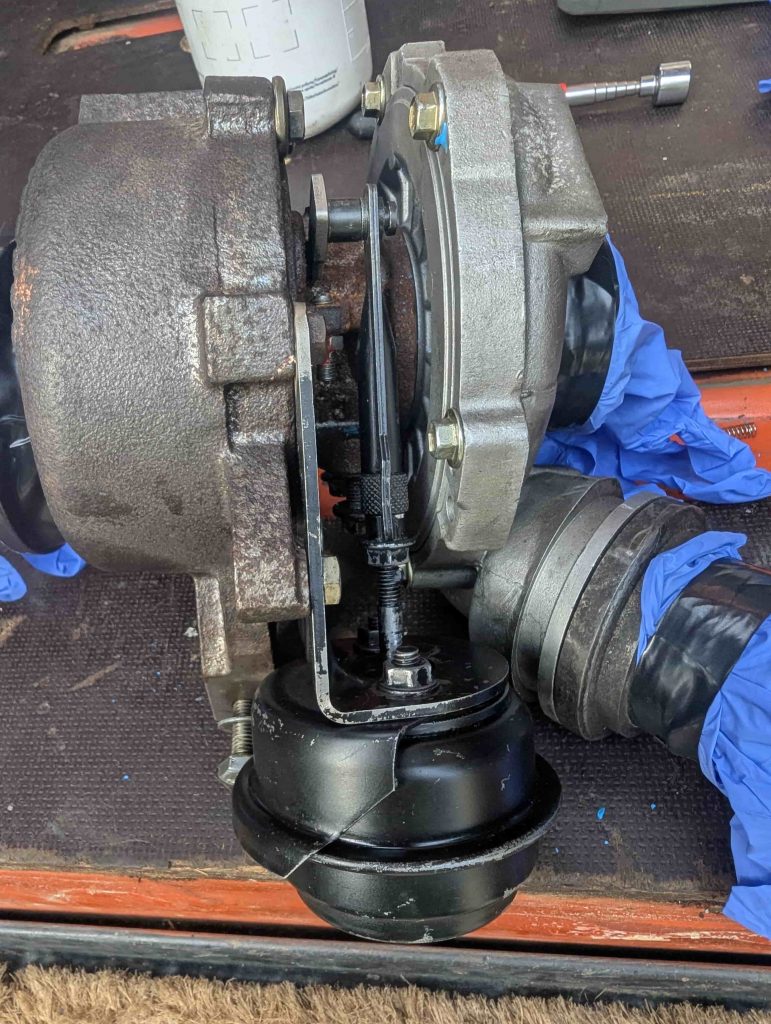
Of course, vacuum on its own is just vacuum, and it needs to be metered out precisely. That’s the job of a small electronic valve called a transducer (you may also see it called a boost-pressure solenoid or an electro-pneumatic converter, same idea). The engine’s computer tells the transducer how much vacuum to pass through to the actuator at any given instant, and so, indirectly, the computer commands the fins. Brain, to valve, to vacuum, to rod, to fins. That’s the chain.
Where it had all gone wrong
Now to the interesting part.
That actuator is supposed to begin moving the rod at a fairly modest vacuum, somewhere around 150 mmHg, and to reach the end of its travel by around 420 mmHg. That’s the window the engine’s computer is designed to work within, and I’d tracked down a technical document for the actuator that confirmed those figures.
But when I tested Morrison’s, the actuator wasn’t starting to move until around 400 mmHg, and wasn’t reaching full travel until something like 700. In other words, the whole operating window had been shifted far out of reach. The vanes weren’t even beginning to close until the vacuum was already up where they should have been very nearly fully deployed. The computer was asking for boost in its normal range, and the actuator was effectively shrugging and saying not yet, not yet, never moving the fins enough to spin the turbo up properly. The turbo was barely engaging at all.
And there it was. The missing power, explained. Morrison hadn’t been ill so much as half-asleep.
The fix, mercifully, was simple in principle: the actuator rod has a threaded adjuster, and by threading it in I could bring the start of its travel back to the correct pressure. I set it so movement began low, back around that 150 mmHg mark, with full travel arriving in the low 400s, right in line with the document. One small, oddly satisfying detail: there was a blob of weld sitting right at the point I eventually adjusted it to. Someone, at some time, had deliberately set this actuator and fixed it in place. I’ll let you draw your own conclusions about that for now; it’s a thread I’ll come back to.
Buttoning it back up
With the actuator set correctly, it was time to reassemble, and that meant new gaskets.
A gasket is simply a thin layer of material that sits in the joint between two metal parts and seals it. Metal surfaces are never perfectly flat, and the gaps between them, however tiny, are more than enough for hot exhaust gas or oil under pressure to escape through. The gasket is squeezed between the two faces and deforms to fill every imperfection, making the joint properly gas- and oil-tight. They’re not reusable, either: once a gasket has been crushed into shape and cooked by exhaust heat, it’s done its job and won’t seal a second time. So every joint I’d opened got a fresh one.
New gaskets in, the turbo went back on: the mount, the exhaust reconnected (and those loose bolts properly torqued this time) the oil drain and feed, the charged-air pipe, the air feed, and finally all the bits and pieces I’d had to strip away to reach the wretched thing in the first place and then check all the fixings are tightened to the correct torque. And away we go.
So, problem solved, full power restored, lesson learned?
Well. That was certainly what I thought as I stood back and admired the job. It was also, as it turned out, only the very beginning. Because the actuator was just the first of the things I was about to discover wrong with Morrison’s turbo circuit.
And it was time to fire it up …