
The van (not Morrison) went off to auction today, and the drive up gave me the better part of three hours to think about how I came to own it at all. So I will set the beginning down first, while the whole shape of the thing is in my head.
It began, properly, more than two years before I ever bought a vehicle. There was a plan, an overland tour that would take us right across the world, and for a long time it lived only as reading, calculation and argument with myself and then discussed with Ochi. Then in 2024 we went for the first time to Abenteuer & Allrad at Bad Kissingen, the great off-road and expedition gathering, around two hundred and fifty exhibitors spread across the ground with everything from roof tents and cookers to vehicles the size of small houses. We gave it two and a half days. We climbed inside as many builds as would let us, talked to the people who make them, and learned more in those few days than in the previous year of reading.
The spread of what was there has stayed with me. At the modest end, Toyota pickups carrying a compact living box on the back, or Ineos Grenadiers fitted out with storage, a few pull-out fittings and a roof tent. At the other, six-wheeled all-wheel-drive monsters with four-wheel steering, twenty tonnes and more, and a handful of eight-wheeled things that looked built to cross a continent without noticing it was there. Walking between the two extremes did most of our deciding for us.
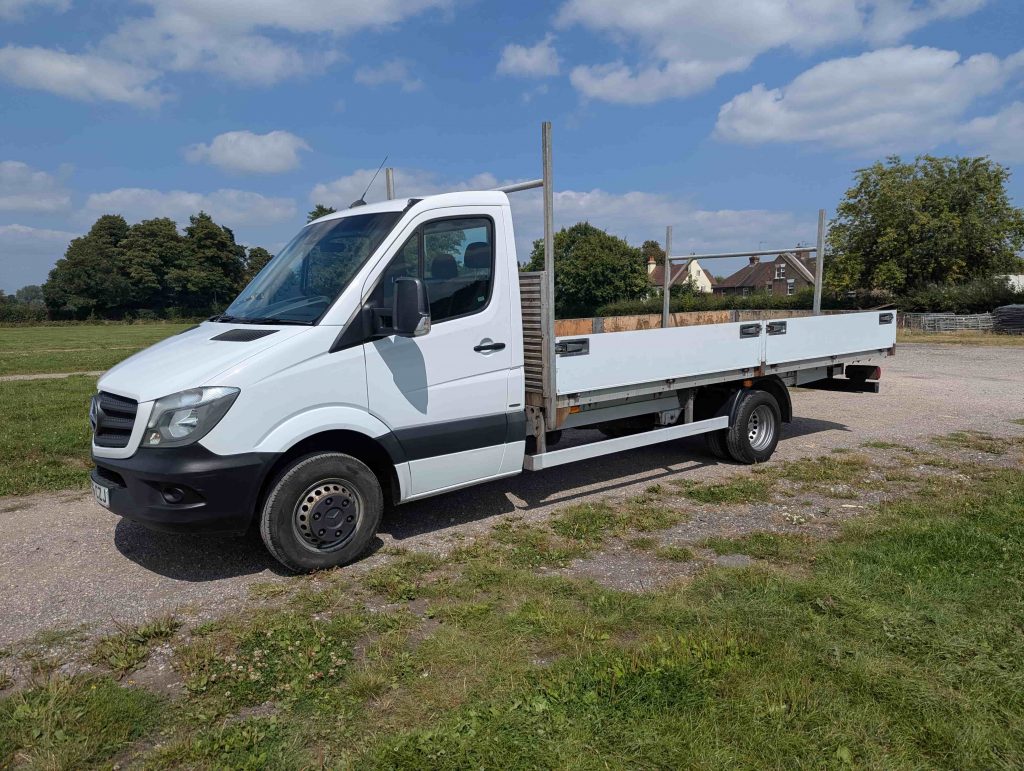
I came home full of it and went straight to the classifieds. Within a short while I had found what looked ideal: a one-owner 2016 Sprinter 516 dropside, extra-long wheelbase, full service history, a hundred and twenty-one thousand miles on it. I bought it.
The design brief in my head was by then quite firm. We did not want one of the fifteen-tonne-plus luxury expedition trucks. They are magnificent, but we wanted to take narrow mountain passes as well as open country, and I wanted to be able to mend the thing myself in a field if it came to that. Changing a wheel on one of the giants means wrestling something close to or over a hundred kilograms; a single military-pattern tyre, a 395/85 R20, is around ninety-five to a hundred kilograms before you even add the rim. That just did not seem like any fun at the roadside in the middle of nowhere. So I set a ceiling of seven and a half tonnes and meant to stay under it.
Against that, we wanted the comforts of home, and comfort costs both volume and weight. I had a target habitation box of roughly five and a half metres by two point two by two point two, divided properly into kitchen, shower room, bedroom and living room, with a garage at the back for bicycles, spares and tools. A washing machine. Air conditioning. Working from those, I reckoned on at least two hundred and fifty litres of water, the washing machine being a thirsty thing, and around fifteen kilowatt-hours of stored energy. The box itself I meant to build in composite throughout, carbon fibre and glass fibre according to where each belonged, and bring in at about two to two and a half tonnes.
The dropside made sense for a reason that seemed obvious once I had it. A dropside body is the easiest of all to strip away, leaving the chassis clean and exposed for a separate habitation box to be mounted on it. The extra-long wheelbase I chose simply because, at the time, I thought we needed a large box to live in.
On paper it was coherent. I had thought it through honestly and the numbers held together. Sitting here now, I can see the seed of the later trouble sitting quietly inside that coherence: a big box, sized for living the way one lives in a comfortable house, set against a wish to travel light and travel far. I did not see it then. I see it now, though I am not yet sure I have fully made my peace with it.
Leave a Reply