
When I left you last, the new transducer was in, everything was reconnected, and I was standing over the engine bay with rather less optimism than the first time and rather more dread. I started him, let him settle, gave the throttle a push, and listened.
Nothing. Again.
No whistle, no whoosh, the revs rising in that same flat, lifeless line. After the wiring, after the sensors, after the transducer, here we were once more, near enough where we had started, with a turbo that turned the fuel into noise and motion and no useful boost whatsoever. I will not pretend I took it well.
A flicker of something
Out came the phone again, propped against the slam panel with the camera trained on the turbo, engine running, throttle blipped, footage reviewed on the bench afterwards with a coffee going cold beside me.
And this time, movement. The actuator lever swung open as the revs climbed and drew back as I lifted off, smooth and willing, doing precisely what a healthy turbo asks of it. The new transducer was passing vacuum properly. The actuator was answering it. The whole long chain I had spent two posts chasing, brain to valve to vacuum to rod to lever, was finally doing its job from one end to the other.
Which was wonderful, and also rather sobering, because it left exactly one suspect standing.
If the command was good, and the vacuum was good, and the lever was moving as it should, and the turbo still wasn’t making boost, then the fault had to lie past the lever, inside the turbo itself. And I already knew a good deal about the inside of this turbo. Back in the first post I had it on the bench and checked the heart of it: the turbine, the shaft and the compressor wheel, all sound, no play, no scoring, no wobble. The spinning parts were fine.
That left only one thing. The vanes. You’ll remember them: the ring of little movable fins inside the exhaust housing that aim the gas at the turbine and decide how hard it spins. The lever was moving. So either the vanes weren’t moving with it, or they weren’t moving at all. Either way the answer was the same, and it was not the answer I wanted.
The turbo had to come off again.
Off it comes
I’ll spare you the full liturgy of disassembly, since you sat through it once already and the steps don’t improve with retelling. The cluster of innocent components around the exhaust side, off. The connections in their order. The exhaust bolts, properly torqued this time and so a fair bit more stubborn than the loose ones I’d found at the start of all this. The mount. And the turbo on the bench, looking smug.
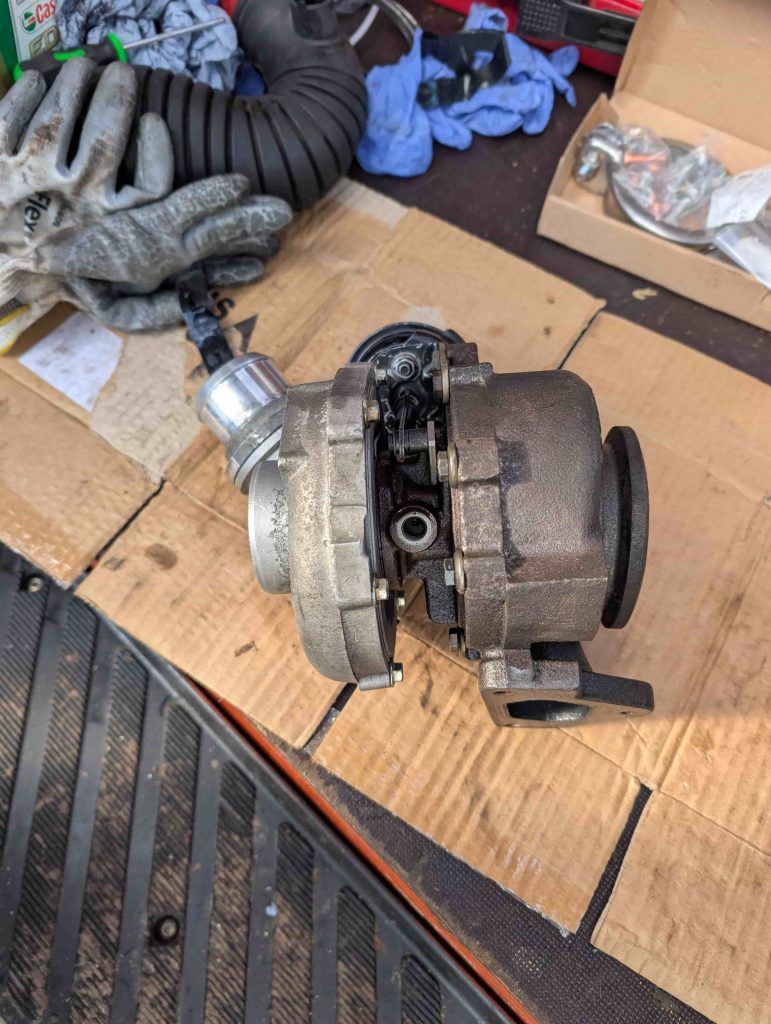
The turbo out and on the bench. The bronze, rust-darkened casting on the right is the exhaust housing, where the vanes live, bolted on around its rim. Getting the bolts out was the easy part.
Have a look at that picture. The bronzy, rust-coloured section on the right is the exhaust housing, and it’s bolted on radially, all the way round its edge. That’s the part the exhaust gas enters, and it’s where the vanes sit. To get at them, that housing had to come away from the rest of the turbo.
The bolts, as I say, came out without much fuss. The housing itself was another matter entirely. Years of heat and exhaust grime had welded the two castings together far more effectively than any bolt ever could, and what should have been a simple parting of two faces became a long argument conducted with a mallet. I tapped, then I hit, then I hit it harder, working round and round the joint, and it gave not a millimetre. My hands took most of the punishment, knuckles grazed on this casting and that bracket, and my temper took the rest. It came off in the end, suddenly, the way these things always do, with a crack and a shower of carbon and very nearly my own knuckles into the workbench.
The thing that was actually broken
And here I have to apologise, because I didn’t take a photograph, and I’ve regretted it ever since, because what was inside was genuinely fascinating to look at.
The mechanism that drives the vanes is a clever piece of geometry. The lever on the outside, the one I’d watched moving so happily on the video, turns a flat disc inside the housing. Around the edge of that disc sits a ring of small cams, one for each vane, and as the disc rotates it nudges every cam, and every cam swings its vane, all of them moving together by the same amount in the same instant. One lever, one disc, a dozen vanes turning as one. It’s the sort of thing you could watch all afternoon.
When it works. Mine didn’t. The little cam that takes the motion from the lever and feeds it into the disc, the very first link in that chain, had snapped clean. So the lever turned, exactly as the video showed, and turned, and the disc behind it sat there doing nothing at all. The whole graceful arrangement of disc and cams and vanes was sitting idle behind a lever that thought it was hard at work.
There was my missing boost, finally, at the very bottom of the well. And there too was nothing I could do about it. A broken internal cam in a sealed turbo is not a repair, or at least not one I’m equipped to make at the kitchen-table end of a driveway. The turbo was finished.
Remanufactured, not new
Which brought me to the till, and an unpleasant moment with it. A brand-new turbo for Morrison, where one can even be found, costs the sort of money that makes you sit down. Remanufactured is the sensible road: you send your old unit in as an exchange, a workshop with the right tooling strips it, replaces what’s worn, and sends one back rebuilt to spec for a fraction of the price of new. So that’s what I did. Box up the old one, send it off, and wait.
A week, near enough, which is by now the standard unit of time in this whole saga. While I waited I ordered a full gasket kit to put it all back together with, and a second kit on top of that to live in the van as a spare. If this restoration has taught me anything, it’s that the part you need is the one you don’t have, a thousand miles from the nearest counter. Better it rides along.
The remanufactured turbo arrived. New gaskets in, every joint fresh, and the whole reverse procession went back together: the mount, the exhaust, the oil feed and drain, the charged-air pipe, the air feed, and the cluster of innocents bolted back over the top, each fixing checked to its proper torque.
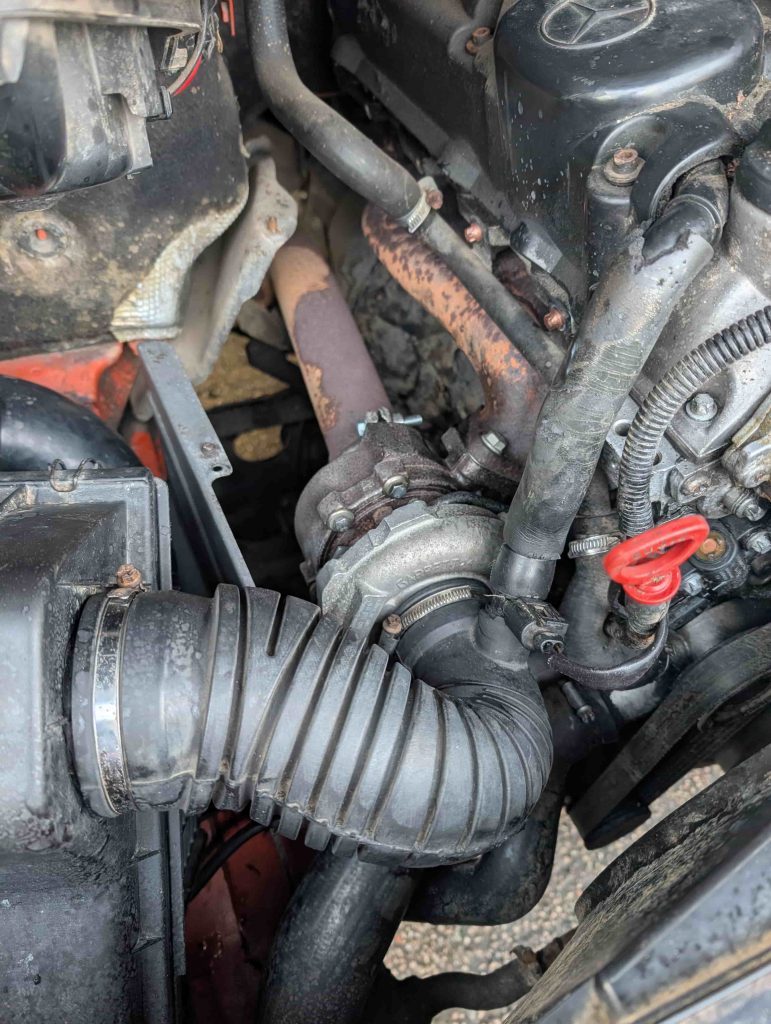
The remanufactured turbo back in its place, plumbed in and torqued down. The last piece, I hoped, of a very long puzzle.
The moment I’d been waiting three posts for
And then there was nothing left to do but start him.
I turned the key. He caught at once and settled to idle, and I made myself leave him there. No revs, no testing, not yet. I let him idle and warm, watching the temperature needle lift off its stop and begin its slow crawl upward, the oil thinning and circulating, everything coming up to heat the way it should before I asked a single thing of it. It was the longest few minutes of the entire job. I’d been disappointed at this exact moment twice before, stood in this exact spot with my hand near the throttle, and twice it had given me nothing.
Needle up. Oil warm. I gave it some revs.
The revs gathered, quickened, and just shy of 1,800 rpm they took hold and surged, and over the top of them came a sound I’d been chasing since the very first post: a clean, rising whistle, the turbo spooling up and piling the air in at last. I lifted off, and there it was, the soft whoosh of the dump as the pressure let go.
I may have made a noise myself, standing there in the cold. I’m not going to tell you what it was.
Drawing the thread back
We had it. The whole turbo circuit, end to end, finally understood and finally working. And it’s worth stepping back to count what that took, because almost nothing came back fixed the way it went in. The actuator, reset off its welded position. The boost-pressure and air-temperature sensors, both renewed. The transducer, replaced. And now the turbo itself, the very part I’d cleared as healthy in the first post, condemned at last by a single broken cam the size of a fingernail. Most of the circuit, in the end. Very nearly the lot of it.
I’ll resist the urge to point a finger at whoever came before me. The welded actuator I found in the first post, the reworked wiring in the second, the broken cam in this one, I think these are mostly just the marks of age and hard miles. Morrison is twenty-five years old and has crossed the Sahara twice. Things wear, things tire, and a vehicle this old is really only the sum of every repair that has kept it on the road this long. Whoever set that actuator and ran that wire was, I suspect, doing their best with whatever was failing under them at the time, exactly as I have been these past weeks.
What I had, that they perhaps didn’t, was the time, the stubbornness, and a blog to answer to. There was never a shortcut here, only the long way round, one ruled-out suspect at a time, all the way down to a broken cam I omitted to photograph. Three posts, the better part of six weeks of waiting on parts and puzzling over multimeters, and something like five days of actual work scattered across them. For a part the size of your fist, that is a great deal of fuss, which is more or less where the turbo page came in, all that time ago.
But Morrison whistles now, and whooshes when he’s done. After all of it, that small noise is the sweetest thing I’ve heard in months.
Next, the steering.
Leave a Reply