Category: The Restomod

  • The Turbo, Part Three – The Whistle and the Whoosh

    When I left you last, the new transducer was in, everything was reconnected, and I was standing over the engine bay with rather less optimism than the first time and rather more dread. I started him, let him settle, gave the throttle a push, and listened.

    Nothing. Again.

    No whistle, no whoosh, the revs rising in that same flat, lifeless line. After the wiring, after the sensors, after the transducer, here we were once more, near enough where we had started, with a turbo that turned the fuel into noise and motion and no useful boost whatsoever. I will not pretend I took it well.

    A flicker of something

    Out came the phone again, propped against the slam panel with the camera trained on the turbo, engine running, throttle blipped, footage reviewed on the bench afterwards with a coffee going cold beside me.

    And this time, movement. The actuator lever swung open as the revs climbed and drew back as I lifted off, smooth and willing, doing precisely what a healthy turbo asks of it. The new transducer was passing vacuum properly. The actuator was answering it. The whole long chain I had spent two posts chasing, brain to valve to vacuum to rod to lever, was finally doing its job from one end to the other.

    Which was wonderful, and also rather sobering, because it left exactly one suspect standing.

    If the command was good, and the vacuum was good, and the lever was moving as it should, and the turbo still wasn’t making boost, then the fault had to lie past the lever, inside the turbo itself. And I already knew a good deal about the inside of this turbo. Back in the first post I had it on the bench and checked the heart of it: the turbine, the shaft and the compressor wheel, all sound, no play, no scoring, no wobble. The spinning parts were fine.

    That left only one thing. The vanes. You’ll remember them: the ring of little movable fins inside the exhaust housing that aim the gas at the turbine and decide how hard it spins. The lever was moving. So either the vanes weren’t moving with it, or they weren’t moving at all. Either way the answer was the same, and it was not the answer I wanted.

    The turbo had to come off again.

    Off it comes

    I’ll spare you the full liturgy of disassembly, since you sat through it once already and the steps don’t improve with retelling. The cluster of innocent components around the exhaust side, off. The connections in their order. The exhaust bolts, properly torqued this time and so a fair bit more stubborn than the loose ones I’d found at the start of all this. The mount. And the turbo on the bench, looking smug.
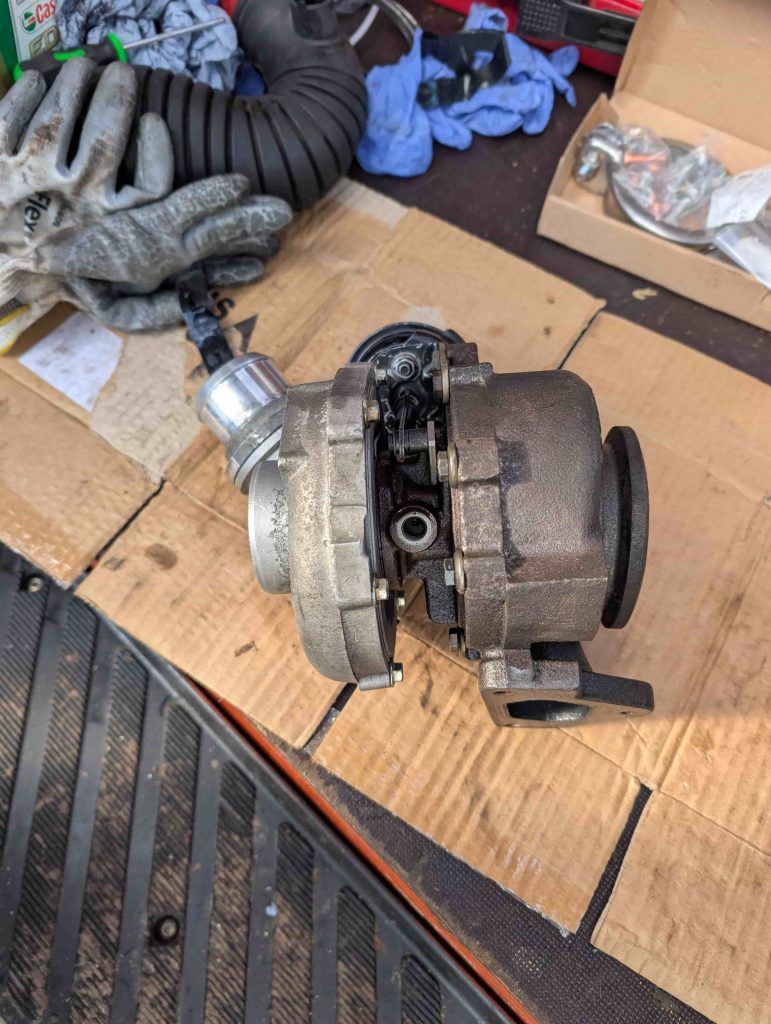
    The turbo out and on the bench. The bronze, rust-darkened casting on the right is the exhaust housing, where the vanes live, bolted on around its rim. Getting the bolts out was the easy part.

    Have a look at that picture. The bronzy, rust-coloured section on the right is the exhaust housing, and it’s bolted on radially, all the way round its edge. That’s the part the exhaust gas enters, and it’s where the vanes sit. To get at them, that housing had to come away from the rest of the turbo.

    The bolts, as I say, came out without much fuss. The housing itself was another matter entirely. Years of heat and exhaust grime had welded the two castings together far more effectively than any bolt ever could, and what should have been a simple parting of two faces became a long argument conducted with a mallet. I tapped, then I hit, then I hit it harder, working round and round the joint, and it gave not a millimetre. My hands took most of the punishment, knuckles grazed on this casting and that bracket, and my temper took the rest. It came off in the end, suddenly, the way these things always do, with a crack and a shower of carbon and very nearly my own knuckles into the workbench.

    The thing that was actually broken

    And here I have to apologise, because I didn’t take a photograph, and I’ve regretted it ever since, because what was inside was genuinely fascinating to look at.

    The mechanism that drives the vanes is a clever piece of geometry. The lever on the outside, the one I’d watched moving so happily on the video, turns a flat disc inside the housing. Around the edge of that disc sits a ring of small cams, one for each vane, and as the disc rotates it nudges every cam, and every cam swings its vane, all of them moving together by the same amount in the same instant. One lever, one disc, a dozen vanes turning as one. It’s the sort of thing you could watch all afternoon.

    When it works. Mine didn’t. The little cam that takes the motion from the lever and feeds it into the disc, the very first link in that chain, had snapped clean. So the lever turned, exactly as the video showed, and turned, and the disc behind it sat there doing nothing at all. The whole graceful arrangement of disc and cams and vanes was sitting idle behind a lever that thought it was hard at work.

    There was my missing boost, finally, at the very bottom of the well. And there too was nothing I could do about it. A broken internal cam in a sealed turbo is not a repair, or at least not one I’m equipped to make at the kitchen-table end of a driveway. The turbo was finished.

    Remanufactured, not new

    Which brought me to the till, and an unpleasant moment with it. A brand-new turbo for Morrison, where one can even be found, costs the sort of money that makes you sit down. Remanufactured is the sensible road: you send your old unit in as an exchange, a workshop with the right tooling strips it, replaces what’s worn, and sends one back rebuilt to spec for a fraction of the price of new. So that’s what I did. Box up the old one, send it off, and wait.

    A week, near enough, which is by now the standard unit of time in this whole saga. While I waited I ordered a full gasket kit to put it all back together with, and a second kit on top of that to live in the van as a spare. If this restoration has taught me anything, it’s that the part you need is the one you don’t have, a thousand miles from the nearest counter. Better it rides along.

    The remanufactured turbo arrived. New gaskets in, every joint fresh, and the whole reverse procession went back together: the mount, the exhaust, the oil feed and drain, the charged-air pipe, the air feed, and the cluster of innocents bolted back over the top, each fixing checked to its proper torque.
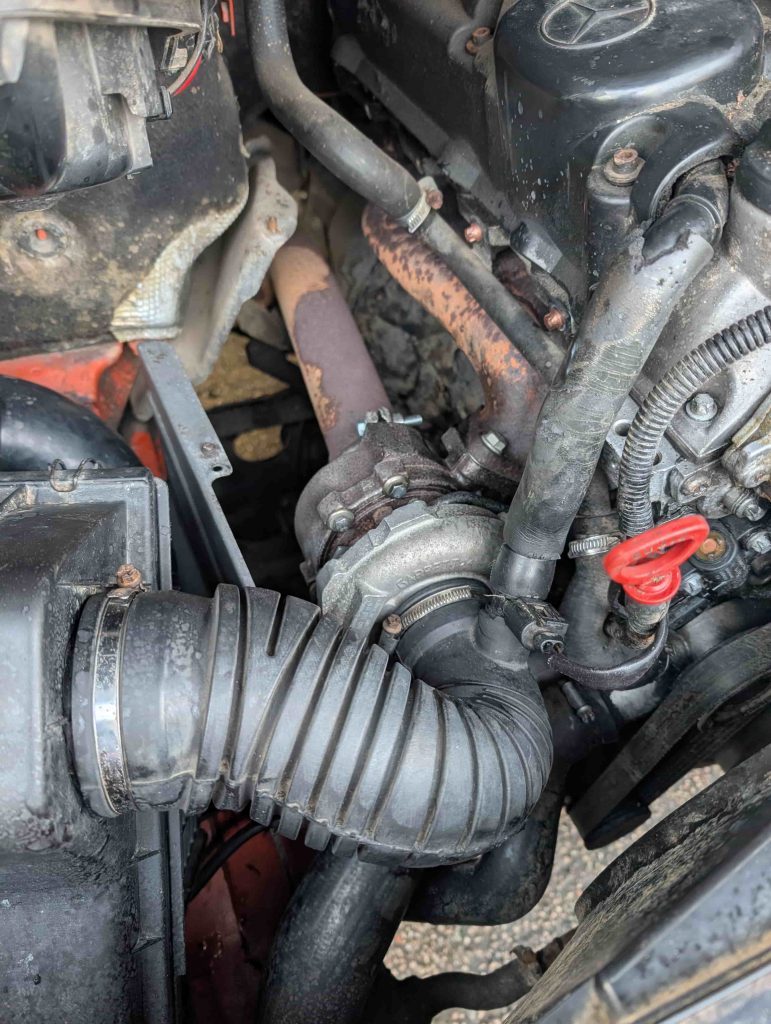
    The remanufactured turbo back in its place, plumbed in and torqued down. The last piece, I hoped, of a very long puzzle.

    The moment I’d been waiting three posts for

    And then there was nothing left to do but start him.

    I turned the key. He caught at once and settled to idle, and I made myself leave him there. No revs, no testing, not yet. I let him idle and warm, watching the temperature needle lift off its stop and begin its slow crawl upward, the oil thinning and circulating, everything coming up to heat the way it should before I asked a single thing of it. It was the longest few minutes of the entire job. I’d been disappointed at this exact moment twice before, stood in this exact spot with my hand near the throttle, and twice it had given me nothing.

    Needle up. Oil warm. I gave it some revs.

    The revs gathered, quickened, and just shy of 1,800 rpm they took hold and surged, and over the top of them came a sound I’d been chasing since the very first post: a clean, rising whistle, the turbo spooling up and piling the air in at last. I lifted off, and there it was, the soft whoosh of the dump as the pressure let go.

    I may have made a noise myself, standing there in the cold. I’m not going to tell you what it was.

    Drawing the thread back

    We had it. The whole turbo circuit, end to end, finally understood and finally working. And it’s worth stepping back to count what that took, because almost nothing came back fixed the way it went in. The actuator, reset off its welded position. The boost-pressure and air-temperature sensors, both renewed. The transducer, replaced. And now the turbo itself, the very part I’d cleared as healthy in the first post, condemned at last by a single broken cam the size of a fingernail. Most of the circuit, in the end. Very nearly the lot of it.

    I’ll resist the urge to point a finger at whoever came before me. The welded actuator I found in the first post, the reworked wiring in the second, the broken cam in this one, I think these are mostly just the marks of age and hard miles. Morrison is twenty-five years old and has crossed the Sahara twice. Things wear, things tire, and a vehicle this old is really only the sum of every repair that has kept it on the road this long. Whoever set that actuator and ran that wire was, I suspect, doing their best with whatever was failing under them at the time, exactly as I have been these past weeks.

    What I had, that they perhaps didn’t, was the time, the stubbornness, and a blog to answer to. There was never a shortcut here, only the long way round, one ruled-out suspect at a time, all the way down to a broken cam I omitted to photograph. Three posts, the better part of six weeks of waiting on parts and puzzling over multimeters, and something like five days of actual work scattered across them. For a part the size of your fist, that is a great deal of fuss, which is more or less where the turbo page came in, all that time ago.

    But Morrison whistles now, and whooshes when he’s done. After all of it, that small noise is the sweetest thing I’ve heard in months.

    Next, the steering.
  • The Turbo, Part Two – The Signal in the Wires

    When we left off last time, the turbo was back in, every fixing checked and checked again, and I was standing over the engine bay with that particular mix of optimism and quiet dread that comes just before you turn the key. So I turned it.

    Morrison started without complaint. I left him ticking over for a few minutes, idling gently, partly to let everything warm through and partly to be sure the oil and the other fluids were circulating properly before I asked anything of him. So far, so good.

    Then the first test. I gave the throttle a gentle push, expecting the revs to gather quickly from around 1,800 rpm (the point where a turbo like Morrison’s typically starts piling on the forced induction in earnest), and expecting, too, to hear something of the turbo’s character: a faint whistle as it spooled up, perhaps a soft whoosh as I lifted off. Instead, nothing. The revs climbed in a straight, flat line, the way a tired engine with no turbo at all would, and not a single turbo-ish noise to be heard. Odd.

    Ruling things out

    Working alone, with nobody to watch the engine while I worked the throttle, I pressed my phone into service as a second pair of eyes. I propped it up with the camera pointed squarely at the turbo, started the engine, blipped the throttle, shut it down, and reviewed the footage. The actuator, the vacuum-driven unit that swings the vanes and the very part I’d spent the last post adjusting, hadn’t moved at all. Not a flicker.

    So began the process of elimination.

    Had I simply forgotten to reconnect the vacuum hose? It would not have been the most embarrassing thing I’d ever done, but the engine bay is a tight place and stranger things have slipped my mind. I went underneath and looked. The hose was there, connected, seated properly.

    Was it blocked, then? I pulled the hose off at both ends, the actuator and the transducer, and blew through it. Clear as anything, no obstruction.

    Had I damaged the actuator itself when I wrestled the turbo back into place? I pushed the vane control arm by hand. It moved through its travel with a firm, reassuring stiffness, exactly as it should. Nothing wrong there either.

    Each suspect, questioned and released. Which left one obvious candidate: the transducer, the little electronic valve that meters the vacuum to the actuator on the engine’s orders.

    Getting at the transducer

    Reaching the transducer is not, it turns out, a five-minute job. To get to it I first had to remove the airbox, and then the headlight, and the headlight in turn was blocked by the light guard, the protective metal cage that sits over the lamp on the bull bar.

    A word on the bull bar, for anyone who hasn’t met one. It’s the sturdy steel frame across the front of the van, the sort you’ll see on vehicles built for remote or rough country. Its job is to protect the front of the vehicle, the radiator, the lights and the vital bits behind them, from the things you might meet a long way from a workshop: an animal in the road, a low branch, a rock thrown up off a bad track. The light guards are part of the same idea, little cages bolted over the lamps to stop a flying stone from putting a headlight out. Excellent when you’re in the middle of nowhere, and mildly infuriating when all you want to do is get a headlight out on your own driveway.

    So: light guard off, headlight out, airbox out. And there, finally exposed, was the transducer, and a surprise sitting alongside it.

    A previous mechanic’s handiwork

    The wires running to the transducer were not standard. The original wiring had been cut away, and a length of non-standard wire spliced in to take its place. I traced this replacement wire back to see where it went, and it led me all the way to the ECU.

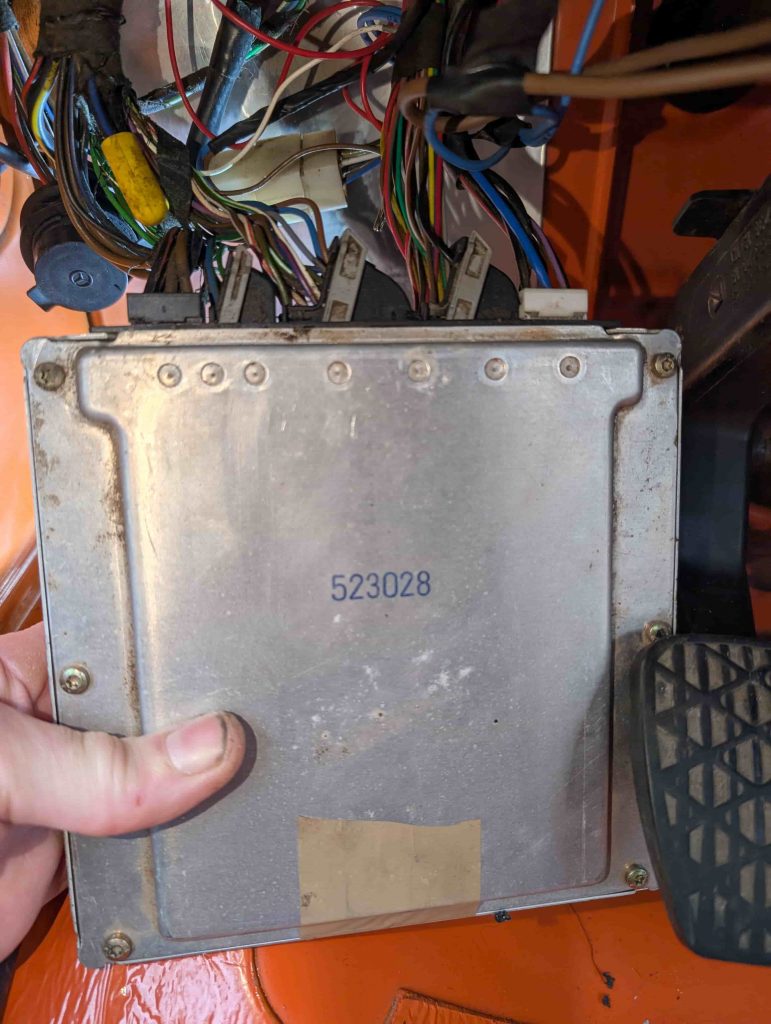
    A quick word on the ECU, since it’s about to become the centre of the story. ECU stands for Engine Control Unit, and it is the engine’s computer, the brain I described last time as sitting at the head of the chain: brain, to valve, to vacuum, to rod, to fins. It’s a sealed box of electronics that reads a host of sensors and decides, many times a second, exactly how the engine should behave, including how much boost the turbo ought to be making and therefore what to tell the transducer.

    The ECU itself, out and in hand. Morrison’s brain. Everything the engine does begins here. Note the rows of multi-pin connectors along the top, each wire landing on its own numbered terminal.

    I followed the replacement wires to the ECU, and right there beside them I found the cut ends of the two original wires, snipped off and abandoned. Someone, at some point in Morrison’s past, had bypassed the factory wiring and run their own.

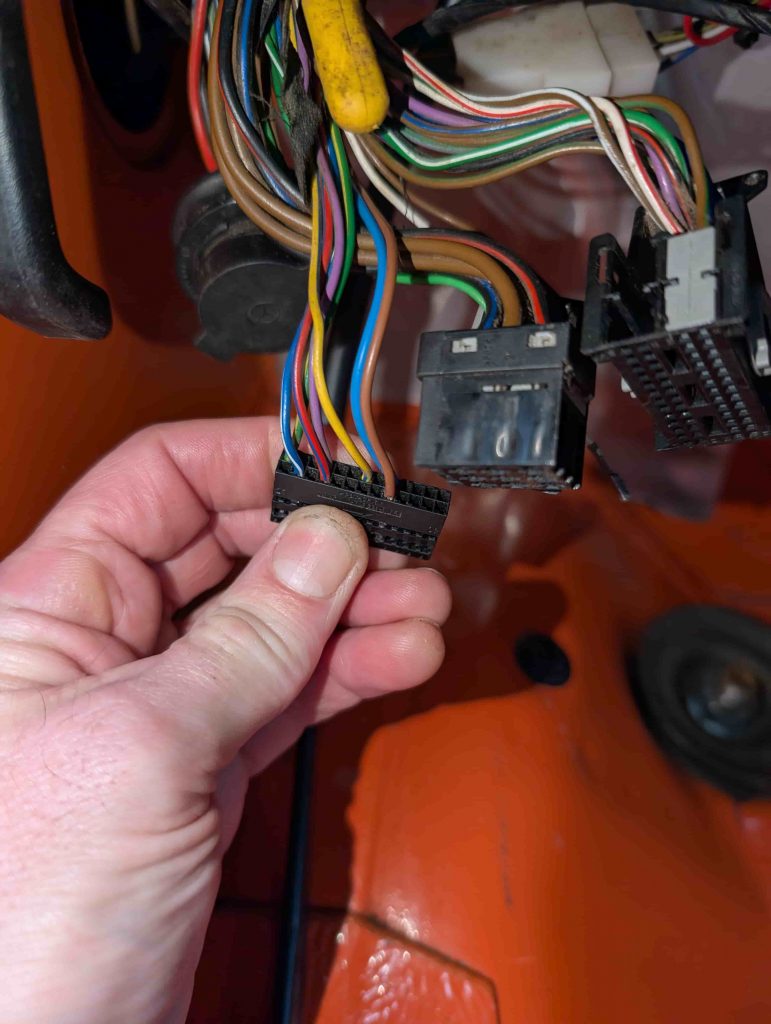
    That raised an immediate and rather worrying question. Had whoever did this actually connected the replacement wires correctly? Wires don’t simply bolt onto a computer; they terminate in a connector, a plug, and within that plug each wire sits in its own numbered slot so that it lands on the correct terminal of the ECU. Getting a wire seated in the right slot is called pinning it. Pin a wire into the wrong cavity and it will sit there looking perfectly connected while its signal goes nowhere useful at all. So: were these wires pinned to the right pins?

    The repinned connector in hand, the spliced-in replacement wires clearly visible (blue and brown). The factory wires were cut and these run in their place, all the way back to the ECU.

    Turning the problem round

    How on earth do you check that, with no documentation to hand? I scoured the internet for a technical wiring diagram for the ECU, the kind that would tell me which pin ought to carry which signal. I came up empty, even among the diagrams you can usually buy for a not-unreasonable fee. Nothing.

    So I turned the problem round. Rather than prove the wiring correct from the diagram inward, I would measure what was actually arriving at the far end and work backward. If the right signal was reaching the transducer, then the wires had to be connected to the right pins and sound along their whole length. The proof would be in the signal.

    Here I need to explain what kind of signal we’re looking for, because it isn’t quite what you might picture. The ECU doesn’t control the transducer with a smoothly varying voltage. It uses something called PWM, or pulse-width modulation. Rather than dimming the supply up and down like a household dimmer switch, the ECU switches the full voltage fully on and fully off, very rapidly, many times a second, and varies the proportion of time it spends switched on. That proportion is the duty cycle. Fifty per cent duty cycle is on half the time; seventy-five per cent is on three-quarters of the time. A solenoid, and a multimeter, both respond to the average, so a signal that’s on 75% of the time reads as roughly 75% of the supply voltage. It’s a tidy way to control something precisely using nothing more than a fast on/off switch.

    One more thing to hold in mind before the numbers: the voltage in a vehicle is not a fixed quantity. We talk loosely about a “12-volt” system, and a battery sitting at rest does read somewhere around 12.6 volts. But the moment the engine starts, the alternator wakes up and begins charging the battery, and to push charge back in it has to work at a higher pressure, typically around 14.4 volts. So the supply voltage in the van climbs from roughly 12 volts with the ignition on and the engine off, up to around 14.4 volts with the engine running and the alternator at full output. This matters, as you’ll see.

    I stripped down the plug that connects to the transducer, put my multimeter across it, set the phone recording once again, and ran the engine. Here is what the video gave me.

    With the ignition off, the reading sat at zero. Turn the ignition on, engine still off, and it jumped to about 9 volts. As I cranked and the engine caught, it dipped to 5.5 (the starter and everything else hauling hard on the battery for a moment), then climbed quickly back to 9.5 as it settled into idle, and crept on up to 10.5 over the next five seconds or so as the alternator got into its stride. I revved it to 3,000 rpm and it nudged up a touch more, to 10.83. Then I switched off, and it fell to 9.26 before dropping away to zero.

    At first glance those wandering numbers look like the ECU busily doing its job, varying the signal as the engine’s state changes. But watch what happens when you measure each one against the supply voltage at that exact moment:

    Ignition on, engine off: 9 volts against a roughly 12-volt battery is 75%.
    Idle just after starting, battery recovering: 9.5 against about 12.7 is 75%.
    Idle after five seconds, alternator charging properly: 10.5 against about 14.0 is 75%.
    At 3,000 rpm, alternator at full chat: 10.83 against about 14.4 is 75%.
    Engine just switched off, a little surface charge left on the battery: 9.26 against about 12.3 is 75%.

    Every single reading comes out at almost exactly 75%. The numbers had nothing to do with the ECU modulating the turbo. They wandered only because the supply voltage beneath them was wandering, and the signal rode passively along on top of it. The duty cycle, the actual command from the ECU, never budged from 75%. Rock steady.

    Two things at once

    Now, that steady 75% told me two things, and the second one took a moment to sink in.

    The first was the answer I’d gone looking for: a clean, coherent PWM signal was reaching the transducer, and that could only be true if the replacement wires were pinned to the correct terminals at the ECU and were sound from end to end. The previous mechanic’s handiwork, whatever else might be said about it, was electrically fine. The wiring came off the suspect list.

    But the second thing was the more interesting, and I’d very nearly walked straight past it. A fixed 75% duty cycle that never moves, no matter what the engine is doing, is not what a healthy ECU produces. A healthy ECU is forever adjusting, nudging the figure up and down as the revs and the load change, chasing the boost it wants moment to moment. A flat, unchanging number is a tell-tale. It’s what an ECU falls back to when it has given up.

    Engine computers are built to be cautious. When one detects that something it relies upon has stopped making sense, a sensor reading that’s drifted out of range, or a result that doesn’t add up, it doesn’t keep trying to do clever calculations on bad information. It abandons proper closed-loop control and retreats to a safe, fixed default, a sort of mechanical shrug. You’ll often hear this called limp mode. In effect the ECU was saying: I can’t work out what the turbo should be doing, so I’ll just hold this one safe value and leave it there. That value was 75%, and it would never move while the fault persisted.

    So the transducer wasn’t necessarily broken at all. It might simply have been faithfully obeying a stuck command. Before I could blame it, I had to find out why the ECU had downed tools in the first place, and that meant looking at the sensors feeding it.

    The sensor the ECU had lost faith in

    The most likely culprit was the boost pressure sensor. This is a small sensor that measures the pressure of the air on its way into the engine, the very thing the turbo exists to raise. It sits between the intercooler and the intake manifold (which is the shared gallery that takes the incoming air and distributes it evenly to each of the cylinders; it’s the last stop for the air before it enters the engine.) That sensor is precisely how the ECU knows whether the turbo is actually delivering. If its reading goes sour, the ECU is suddenly blind to the one measurement it most needs, and limp mode is exactly the sort of response you’d expect.

    Sitting right beside it was an air temperature sensor, which tells the ECU how hot that incoming air is (and therefore, as we covered on the turbo page, how much oxygen it really contains). Two sensors, side by side, both feeding the same decision. Rather than test each in isolation and risk replacing one only to find the other at fault, I decided to renew them both together. I ordered them up, waited the by-now-customary week for them to arrive, and fitted them.

    Then I ran the same test again, multimeter on the transducer plug, phone recording. And this time the picture was quite different. As I worked the throttle, the duty cycle came alive, swinging across the full range from 0 to 100% as the revs rose and fell, exactly the restless, adjusting behaviour of an ECU doing its job properly. The computer had its sight back. Replacing those sensors had cleared whatever fault had blinded it.

    But, and there’s always a but in this story, it didn’t last. After a few seconds of proper control the duty cycle gave up and settled back to that same flat 75%. The ECU would start out trying, then quietly retreat to limp mode all over again.

    That actually made perfect sense once I thought it through. The ECU now had good sensors and was willing to command boost. But it commands boost and then watches the boost sensor to see it arrive. If it asks for boost and nothing happens, no rise in pressure, no response at all, then as far as the ECU is concerned something downstream is still broken, and back to the safe default it goes. The sensors had been one fault. There was clearly another, further down the chain.

    Back to the transducer after all

    So now, with the wiring cleared and the sensors replaced, I came back round to the transducer with a much better idea of what I was testing. I connected my vacuum tester to the output of the transducer, the side that feeds the actuator, set the phone recording, and ran the engine.

    Nothing. No vacuum at all.

    This needs a small clarification, because the transducer doesn’t actually make vacuum. It’s only a valve. The vacuum itself is generated by a pump on the engine and held in a small reservoir nearby, ready to be drawn upon, and the transducer’s job is simply to meter out as much of that stored vacuum as the ECU asks for. So no vacuum at the transducer’s output could mean a faulty transducer, or it could mean there was no vacuum arriving at its input to begin with.

    So I ran the same test one step further back, on the output of the reservoir. This time the gauge showed a brisk build-up of vacuum from the moment the engine started, climbing to around 700 mmHg and holding there. The supply was perfect, plenty of vacuum, exactly where it should be. For good measure I checked the short length of pipe between the reservoir and the transducer, and that was sound too.

    Which left only one possible conclusion. Good vacuum was arriving at the transducer. A live, willing PWM signal was arriving at the transducer. And still nothing came out the other side. After all the rerouting and ruling-out, the thing I’d suspected at the very start turned out to be guilty after all. The transducer was also broken.

    A new part, and a held breath

    I ordered a replacement. A week later it arrived. I fitted it, reconnected everything, and, with rather less optimism and rather more dread than the first time around, started the engine, gave it some revs, and…

  • I’m back, and the diary starts again

    I’ve been off-message, off-brand, off me box this past long while, head down in the slog of it, and not a word posted to show for it. That ends here.

    A short word on where the time went, and then the good part. The house and garden have eaten more of these last six months than I care to admit, scrubbed, mended and made presentable for sale, because the travelling years do not begin until someone else holds the keys to this place. It is dull work and I will not dwell on it. It is nearly done.

    What I will dwell on is the van. Morrison is, as I write, stripped back to the bare shell, every system out, the metalwork laid open and honest before me, mid-way through a restoration thorough enough to earn the next quarter-century. There is a great deal to tell, the turbo, the steering, the great interior strip-down and all that has followed, and I mean to tell it properly in catch-up entries as the time comes. It has not been silence for want of doing. Quite the opposite.

    But a van under restoration is a van going nowhere, and a blog needs the open road as much as the workshop. So before the catch-ups begin, something different.

    The next four entries that follow this one are not about Morrison at all. They are from a long weekend Ochi and I took at the start of June, driving the old SL280 across to Germany for the Abenteuer & Allrad show at Bad Kissingen, four days of it set down as they happened: the drive out, the show ground and everything on it we coveted or carried home, and two slower days in a Bavarian spa town that has quietly become a place we return to. The show is where a good deal of the habitation plan took shape, the toilet, the mattress, the forty-eight-volt question, the recirculating shower, so it feeds directly back into the build even if there is not a spanner in sight.

    I will post them separately over the coming days. Read them as a breather between the heavy lifting, and as a reminder of what all the heavy lifting is actually for.

    The tools are still out. The work goes on. Watch this space, properly this time.

  • The Maiden Voyage

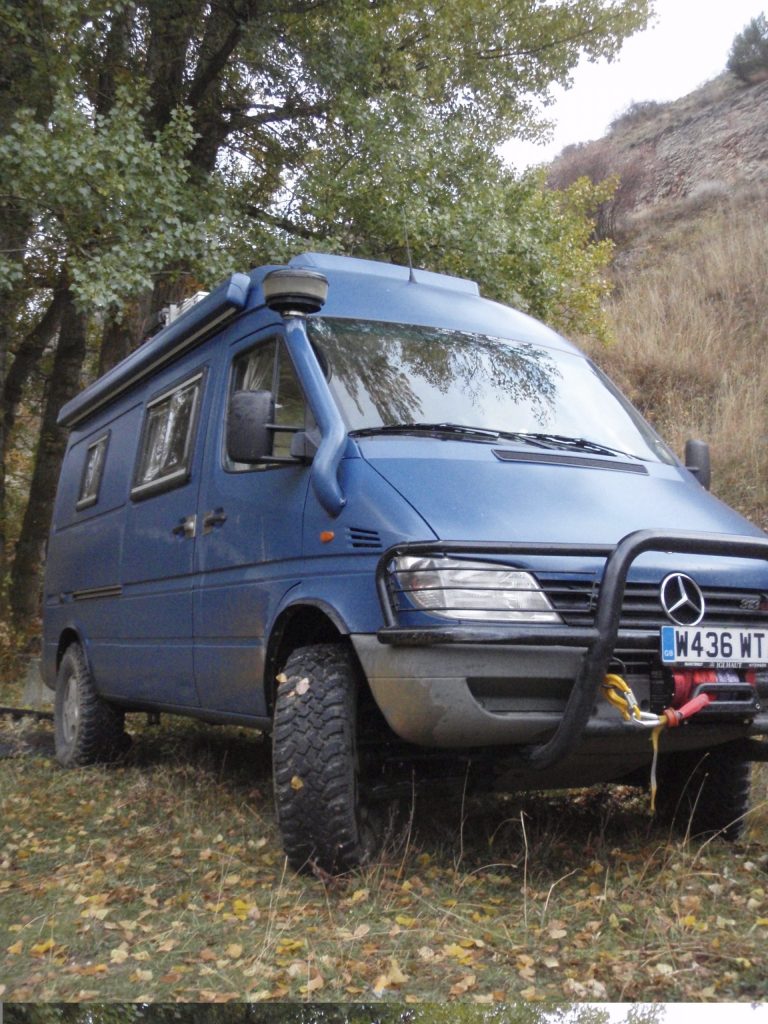
    The transaction with Rory is complete, the keys have been handed over, and the vehicle is officially ours. Naturally, the euphoria of procurement was immediately tempered by the reality of the task at hand: the one hundred and thirty-mile transit to bring Morrison home.

    We were acutely aware during the initial test drive that the turbocharger was singing its swan song. It wasn’t yet making any truly catastrophic noises, so we took a calculated risk to limp it home. The journey was, to put it mildly, sedate. The single carriageway sections of the A303 provided their usual bottleneck, and given our reluctance to push the engine, I fear we may have been the architects of some significant tailbacks. If you were stuck behind a rather tentative-looking campervan recently, do accept my humblest apologies.

    It was during this long, slow procession that I had ample time to acquaint myself with the vehicle’s idiosyncrasies. I noted a distinct vagueness in the steering; play that felt beyond the usual character of such a machine. Then, to add a dash of adrenaline to the final leg, as we navigated the exit slip off the M25, the side door decided to liberate itself from the latch mechanism, sliding open entirely of its own accord. A spirited end to the journey, indeed.

    Safely back at headquarters, I have been able to conduct a proper post-mortem.

    Upon turning the key now, the turbo has developed a decided rattle. To prevent the impeller shattering and feeding metal shards into the engine, replacing this unit has become the highest priority. The vehicle shall remain grounded until this is rectified. The turbo was replaced only 8,000 miles ago, which, I think points the finger squarely at oil starvation. Consequently, I shall be examining the oil feed and return lines to ensure we do not find ourselves in this position again.

    The steering diagnosis proved slightly less grim. While oversized tyres invariably place undue stress on steering components, the issue does not appear to be the universal joint on the lower column (which was replaced relatively recently). Rather, the play seems to stem from a missing grommet where the column passes through the bulkhead. A simple fix, one hopes.

    Finally, the self-opening door. The diagnosis is straightforward, worn runners, but the remedy is less so. Accessing the mechanism requires the removal of the entire kitchen unit. While this turns a small job into a significant project, it is a blessing in disguise; stripping the interior will allow me to properly assess the condition of the internal metalwork.

    These three items: the turbo, the steering, and the great interior strip-down will form the basis of our next few entries. The real work begins now.