
or, how an engine makes power out of its own waste
A note set to one side from the main story, for anyone who wants to understand what a turbocharger is before I get into what I did to Morrison’s. Skip it if the workings don’t interest you, the rest of the blog reads fine without it.
Start with the basics
An engine makes power by burning fuel. It pulls air and fuel into a cylinder, squeezes them, and burns them. The burn pushes a piston down, and that push, repeated thousands of times a minute, is what turns the wheels.
The key thing to hold onto is this: you can’t burn fuel without air. Specifically, oxygen. So if you want more power, you need a bigger burn, and a bigger burn needs more fuel and more air to burn it with. Add fuel without adding air and the extra simply doesn’t burn, it leaves as black smoke out the back. That sooty cloud behind a struggling lorry is wasted fuel that never found enough oxygen.
So the real problem, if you want more power, is getting more air into the engine.
The ordinary way: just breathe
Most engines are what’s called naturally aspirated. As the piston travels down, it creates a partial vacuum, and the surrounding air simply pushes in to fill the space. The engine breathes in, much as we do, and like us, it’s limited to whatever the atmosphere happens to be offering. On a normal day that’s about as much air as you’ll ever get for free.
If you want more than that, you have to stop waiting for the air to wander in and start forcing it in. This is called forced induction: using a pump to cram more air into the cylinder than it could ever draw in by itself. More air means room for more fuel, and more fuel means more power.
Two ways to drive the pump
The pump that does the cramming is, in essence, an air compressor. The question is what spins it.
One option is to drive it straight off the engine. Deep inside the engine is a spinning shaft, the crankshaft, which is what all those pistons are actually pushing on; it’s the part that gathers up their effort and sends it, eventually, to the wheels. Run a belt from that shaft to the pump and the engine spins its own compressor. That’s a supercharger. It works well and responds instantly, but there’s an obvious snag: you’re using some of the engine’s own power to run it. You’re robbing Peter to pay Paul. It still comes out ahead, but you’re paying for the air with effort the engine could have spent on the road.
The other option is far cleverer, and it’s the one Morrison uses.
The turbo: power from the rubbish bin
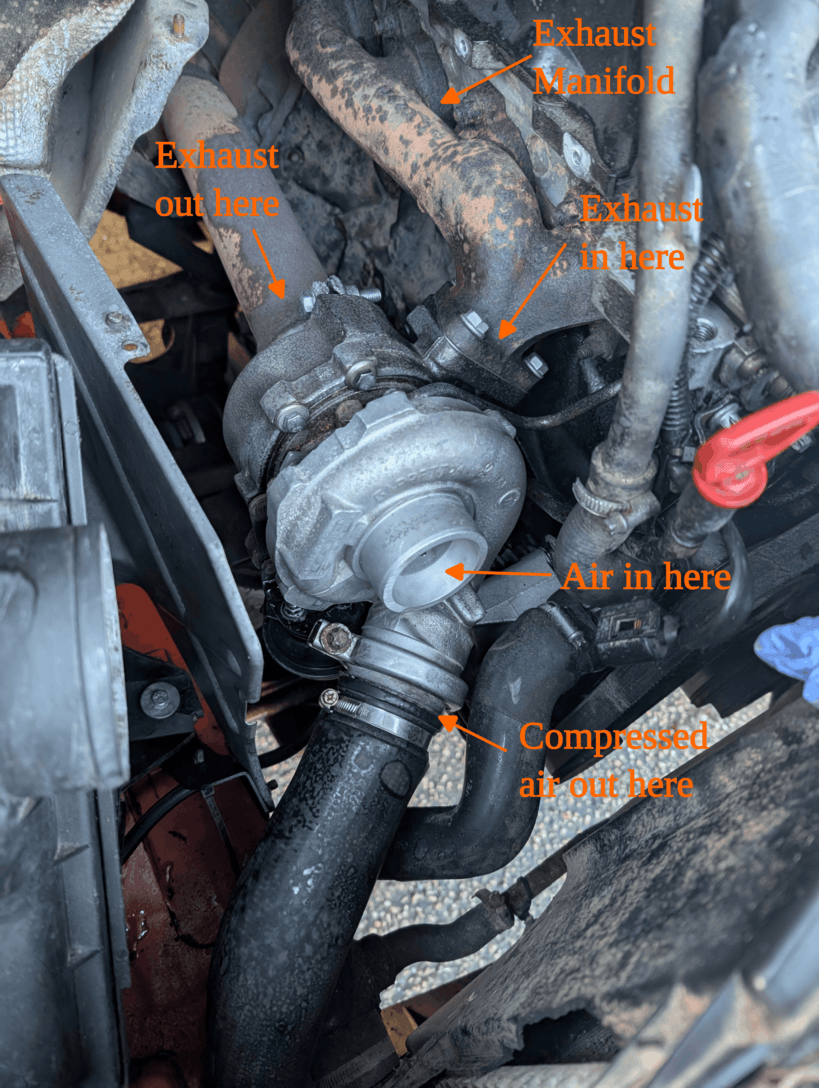
Every engine throws away a huge amount of energy. After the fuel burns and shoves the piston down, the spent exhaust gases rush out: hot, fast, and, in an ordinary engine, completely wasted. They just disappear out of the pipe. A turbocharger catches them on the way out.
Picture two fans joined by a single shaft, like a tiny dumbbell. One fan (the turbine) sits in the exhaust stream. As the waste gases blast past, they spin it, the way wind spins a windmill.
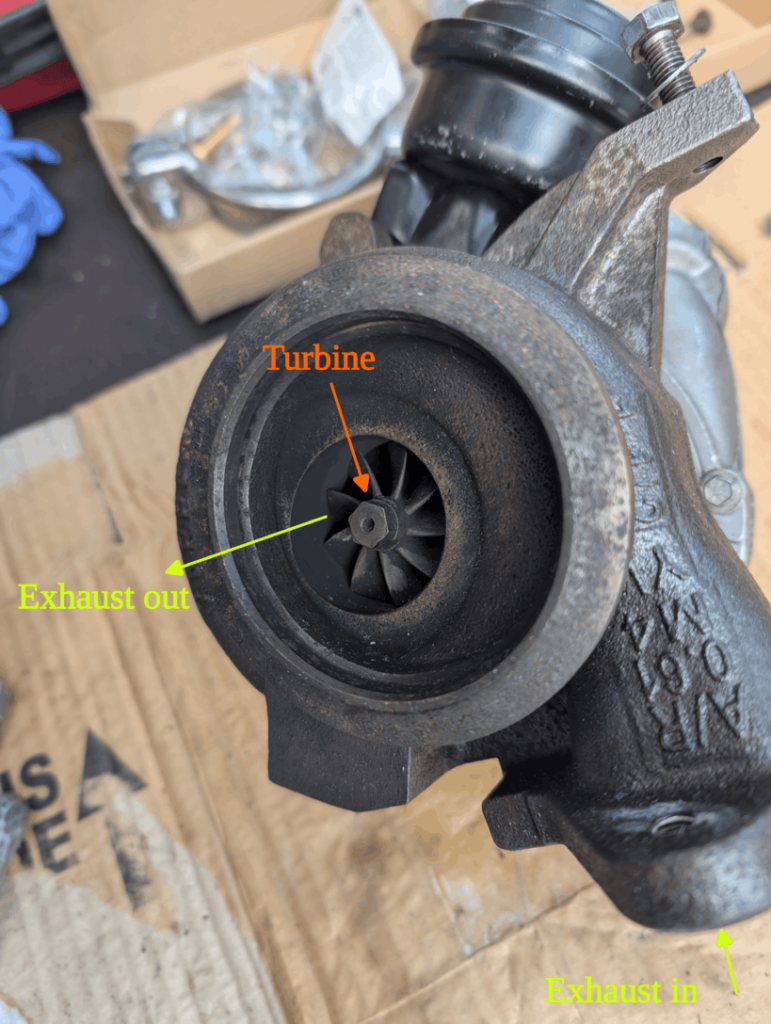
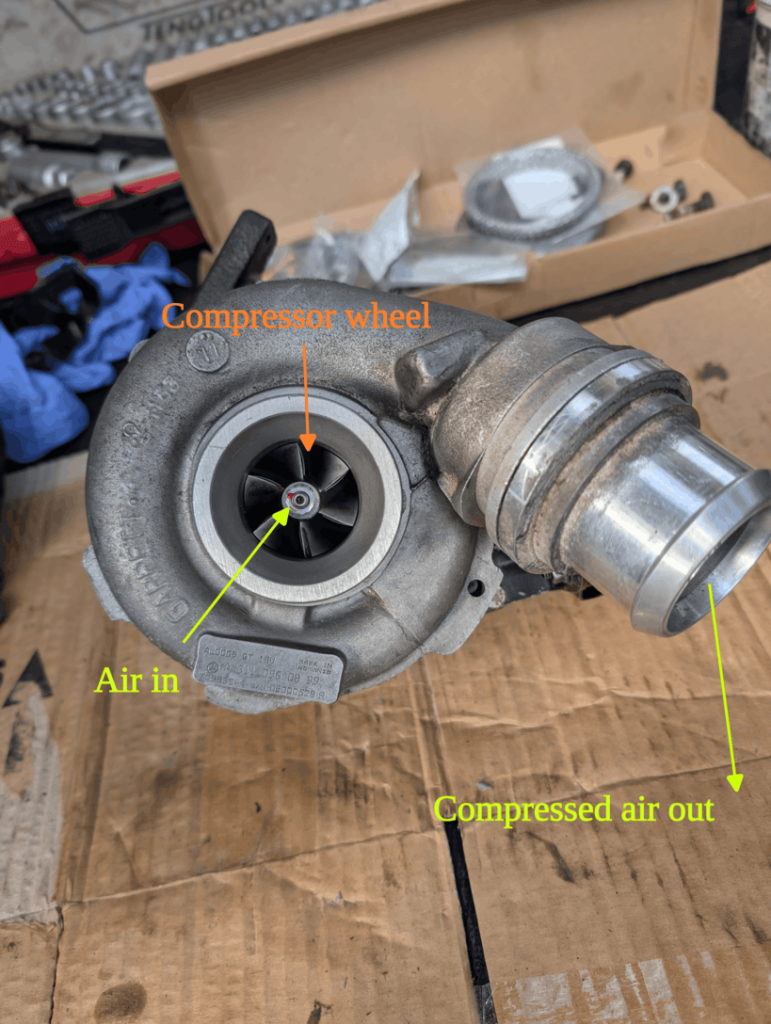
Because the two fans share a shaft, the second one (the compressor wheel) spins too, and that one sits in the intake, sucking in fresh air and forcing it into the engine under pressure.
That’s the whole trick, and it’s genuinely elegant: the engine’s own waste does the work. You’re not taking power back out of the engine the way a supercharger does. You’re picking up energy that was about to be thrown away and using it to shovel more air in. Free power, more or less, out of the rubbish bin.
So what’s the catch?
There’s always a catch, and with a turbo there are two worth knowing.
The first is heat. Squeezing air heats it up; you can feel this in a bicycle pump, where the bottom gets warm as you pump. That’s a nuisance here, because hot air is thinner air: fewer oxygen molecules in the same space, which is the opposite of what we wanted. So the compressed air is run through an intercooler (basically a small radiator) to cool it back down and pack the oxygen in tight again before it reaches the engine.
The second catch is the one that matters for Morrison. To catch all that exhaust energy, the turbo’s shaft has to spin astonishingly fast, well over a hundred thousand revolutions a minute, far quicker than anything else in the vehicle. Nothing solid could touch it at that speed and survive. So the shaft doesn’t rest on anything solid: it floats on a constant, thin film of engine oil, which both holds it steady and carries away the heat.
And that’s the Achilles’ heel. The whole arrangement depends on that oil arriving, cleanly and without interruption, every moment the engine is running. Take the oil away, even briefly, and there’s nothing left to hold the shaft or cool it: the bearings fail in seconds, the spinning parts start grinding against their housing, and metal begins shedding into an engine that cannot tolerate it.
So when a turbo lets go, it’s rarely a simple thing, and Morrison’s, as it turned out, was anything but. That’s a story in its own right, and one I’ll give the room it deserves in a post of its own. Everything above is really just to explain why a part the size of your fist, spinning faster than anything else on the van and fed by one thin pipe of oil, deserves quite this much fuss.